
Why IoT devices need a lightweight protocol like MQTT
Aliste's smart sub-meters, EMS (energy management system) devices and automation controllers are small, often power-constrained devices running on Wi-Fi or cellular connections that aren't always reliable. MQTT (Message Queuing Telemetry Transport) was built for exactly this kind of constraint: a lightweight publish/subscribe protocol that keeps a persistent, low-overhead connection open and pushes data the instant something changes, rather than repeatedly polling a server and draining battery and bandwidth in the process. That efficiency is why MQTT has become the default choice across industrial IoT, smart metering and connected-building deployments - Aliste's included.
The basics: publishers, subscribers and a broker
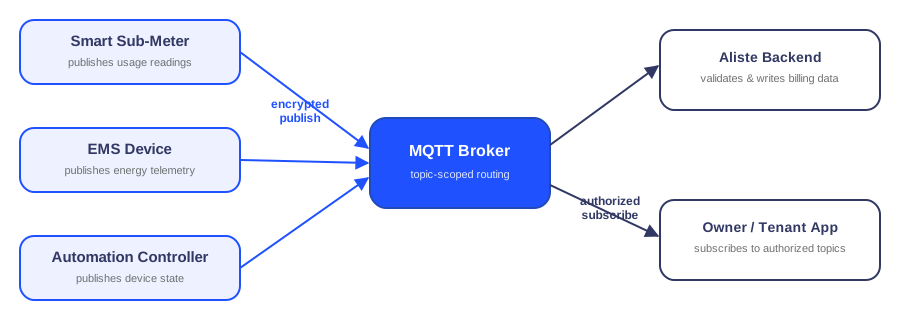
Devices don't talk to each other or to the backend directly. Every device publishes readings to a topic on a central broker - a message router - and any authorized subscriber (Aliste's backend, a dashboard, an alerting service) receives that message the instant it arrives. Topics work like structured addresses: a given sub-meter publishes only to a topic scoped to its own device ID, nothing broader.
Why "just using MQTT" isn't secure by default
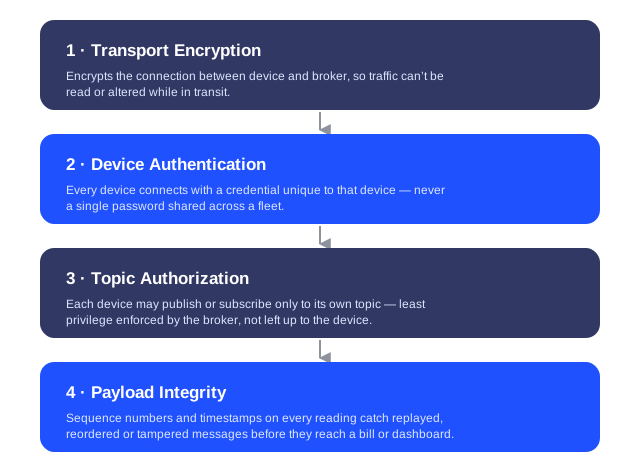
MQTT itself provides no built-in encryption and no required authentication - anyone who can reach an unprotected broker can publish or subscribe to a topic. That's a serious problem for a protocol carrying electricity usage and billing data: an unsecured deployment would let anyone eavesdrop on a device's readings or, worse, publish fabricated data pretending to be a real meter. Building a secure IoT platform means adding four things on top of MQTT itself: encryption, authentication, authorization and integrity.
Layer 1: Encrypting the wire
Every connection between an Aliste device and the broker runs over an encrypted transport, so a reading in transit can't be read or silently altered by anyone sitting on the same network. This is the baseline - it protects the pipe, but on its own it doesn't yet prove who's on either end of it. That's what the next layer is for.
Layer 2: Proving a device is who it claims to be
Every device connects with a credential unique to that device - not one shared password used across an entire fleet. In practice, this means:
- A device that hasn't been legitimately provisioned by Aliste cannot connect to the broker at all, let alone start publishing readings.
- One device's credential cannot be reused to pose as a different device. Impersonating a specific meter requires possessing that meter's own unique credential - not just network access or knowledge of the protocol.
- Compromising one device does not compromise the fleet. Each credential is scoped to a single device, so it can't be used to authenticate as anything else.
Layer 3: Limiting what a device can do
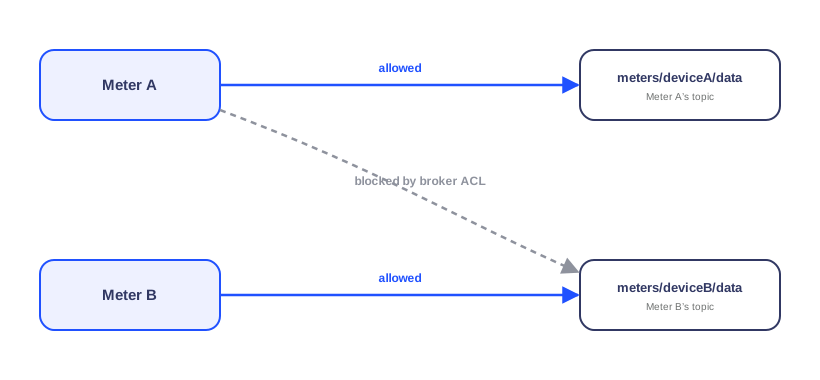
Authentication proves who a device is; authorization decides what it's allowed to do once connected. Every device is restricted to publishing and subscribing only within its own topic - enforced by the broker's access rules, not left to the device to self-police. A device with valid, verified credentials still cannot read another device's topic, or publish into it, because its access is scoped narrowly by design.
Layer 4: Making sure the data itself hasn't been tampered with
Encryption and access control govern who can send and read messages; a separate set of checks governs whether a message can be trusted once it arrives. Every reading carries a sequence number and timestamp, so a replayed or reordered message - for example, an old balance reading resent to look like a fresh one - is detected and rejected rather than processed. Incoming payloads are validated against the expected shape and sane value ranges for that device type before anything is written to a billing ledger or a dashboard, and delivery is acknowledged rather than fired blind, so a reading meant to update a tenant's balance isn't silently dropped or duplicated.
Putting it together: what this makes practically impossible
Stacked together, these four layers give every Aliste smart meter, EMS device and automation controller the same set of guarantees:
- No device can be impersonated. Publishing data under a given device's identity requires that specific device's own credential, not just access to the network it's on.
- No one can silently read another device's data. A device or client with no permission on a topic gets nothing from it - not by accident, not by probing.
- No message can be replayed or altered without detection. Tampering breaks the sequence or timestamp check and is rejected before it ever reaches a bill or a dashboard.
Why this matters for enterprise deployments
For a single household, this can sound like more security than the situation calls for. For an enterprise customer running Aliste's sub-meters and EMS devices across dozens or hundreds of units - a co-living operator, a commercial landlord, a facilities management team - it's the difference between a system procurement can actually sign off on and one it can't. Billing data has to be trustworthy enough to invoice on, and building-management data has to be trustworthy enough to base load-shedding or HVAC decisions on. Designing device communication so that impersonation, unauthorized reads and silent tampering are all independently blocked is what makes that level of trust possible at scale.
Frequently asked questions
Is MQTT secure by default?
No. Plain MQTT provides no built-in encryption or authentication - anyone who can reach the broker can publish or subscribe to a topic left unprotected. Security has to be added at the transport, authentication, authorization and application layers, which is what a production deployment like Aliste's does.
Why MQTT instead of plain HTTPS for IoT devices?
MQTT keeps a persistent, low-overhead connection open and pushes data the instant it changes, which suits battery-powered and intermittently connected devices better than repeated HTTPS polling. Security is layered on top the same way it would be for any protocol - choosing MQTT isn't a security trade-off, just a more efficient transport for constrained devices.
What's the difference between authentication and authorization in this context?
Authentication proves a device is who it claims to be, using a credential unique to that device. Authorization decides what that verified device is allowed to do once connected - specifically, which topics it can publish or subscribe to. A device can be authenticated and still be denied access to data that isn't its own.
Can someone eavesdrop on a meter's data or pretend to be a device on the same network?
No. The connection between every device and the broker is encrypted, so traffic can't be read in transit. Publishing as a given device requires that device's own unique credential, so it can't be impersonated by another party on the network. And even an authenticated device is restricted to its own topic, so it cannot read another device's data.
Evaluating Aliste for an enterprise rollout?
See how our platform secures device communication at scale, across sub-meters, EMS devices and automation controllers.
Talk to our team